A brilliant engineer freezes during a presentation.
A confident manager avoids speaking up in meetings.
A student knows the answer but hesitates to raise their hand.
Different people. Different situations. One common challenge: the fear of public speaking.
If you’ve ever experienced it, you’re not alone. And it doesn’t mean you’re a poor communicator.
In fact, public speaking anxiety is extremely common, even among experienced speakers. Toastmasters International notes that many people experience some level of anxiety when speaking in front of others and that this fear can be managed through preparation, practice, and repeated exposure. (Toastmasters International)
The Fear Is More Normal Than You Think
Many people assume they’re simply not good at speaking in front of others.
But the fear of public speaking, often called glossophobia, is a common human response. And interestingly, the fear isn’t always about speaking itself.
Often, it’s about being judged.
When you stand in front of a group, your brain becomes highly aware that people are watching, listening, and evaluating you. That can trigger your body’s natural stress response.
Your palms may become sweaty.
Your heart may start racing.
Your breathing may change.
Your voice may feel less steady.
And sometimes, the thoughts you knew perfectly well just a few minutes earlier suddenly seem to disappear.
That doesn’t mean you’re incapable of speaking.
It means your brain and body are responding to a situation they perceive as stressful.
Why Does Our Brain React This Way?
Humans are social beings. Being accepted by a group has always mattered to us.
So when we feel that other people are evaluating us, our brains can interpret the situation as a threat.
Today, forgetting a line during a presentation obviously isn’t a life-or-death situation. But our body’s fight, flight, or freeze response can still activate when we feel exposed or judged.
That’s why you might experience a racing heart, tense muscles, shallow breathing, or even a temporary mental blank when it’s your turn to speak. (Toastmasters International)
The important thing to remember is this:
Feeling nervous doesn’t mean you’re not ready.
Sometimes, it simply means that what you’re about to do matters to you.
Avoiding the Fear Can Make It Stronger
Here’s where things get interesting.
Imagine you’re nervous about speaking during a meeting.
You have something valuable to say, but you decide not to raise your hand.
You feel relieved.
The next time a similar situation comes up, you stay quiet again.
Once again, you feel temporary relief.
Your brain can start making a connection:
Speaking feels dangerous. Avoiding it feels safe.
The more you avoid speaking, the fewer opportunities you have to discover that you can actually handle it.
This is why avoidance can keep public speaking anxiety going.
The good news is that the opposite can also happen.
Confidence Is Built Through Experience
You speak even though you’re nervous.
Your presentation isn’t perfect, but you get through it.
You answer a question in a meeting.
You volunteer for a small speaking role.
You give another presentation.
And each time, your brain gets new evidence:
“I was nervous, but I managed.”
Eventually, that can become:
“I can do this.”
That is how confidence grows.
Not by waiting until you stop feeling nervous, but by gradually learning that nervousness doesn’t have to stop you.
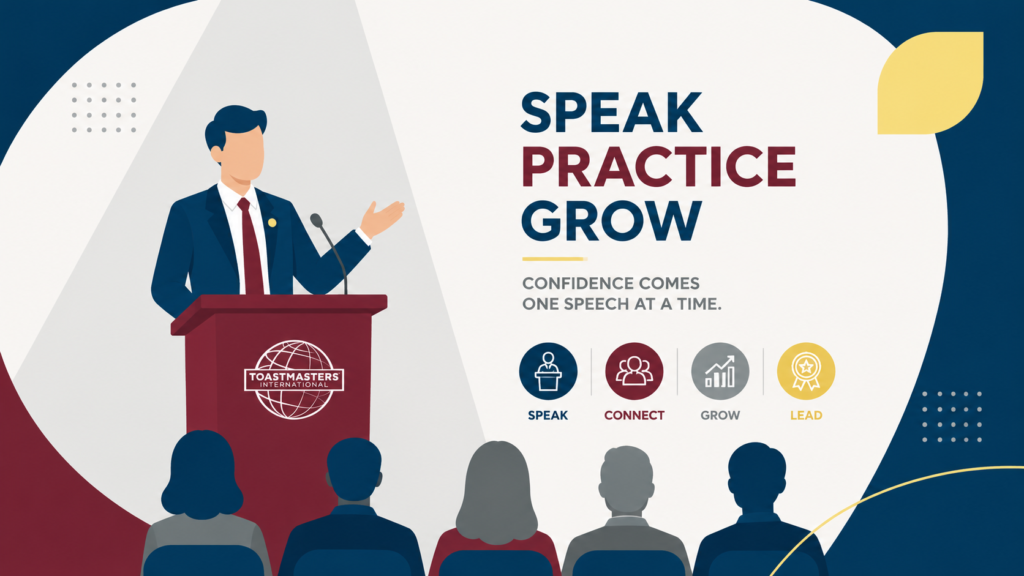
Toastmasters encourages exactly this kind of repeated practice. Members get opportunities to speak, take meeting roles, receive feedback, and gradually become more comfortable in front of others. (Toastmasters International)
You Don’t Have to Become Fearless
One of the biggest misconceptions about confident speakers is that they never feel nervous.
That isn’t necessarily true.
Even experienced speakers can feel nervous before stepping on stage.
The difference is that they have learned how to work with those feelings rather than letting them control what they do.
Confidence doesn’t mean having zero fear.
Confidence means knowing you can move forward even when you feel it.
The speakers you admire weren’t necessarily born fearless. They built their confidence through practice, experience, feedback, and countless small moments of stepping outside their comfort zone.
Practice in a Place Where It’s Safe to Make Mistakes
Learning to speak confidently is much easier when you have an environment where you can practice without the pressure of being perfect.
You can try.
You can make mistakes.
You can receive feedback.
You can try again.
And slowly, something changes.
The things that once felt intimidating begin to feel familiar.
That’s one of the reasons Toastmasters can be such a valuable environment for developing communication skills. The organization provides structured opportunities to practice speaking and receive constructive feedback in a supportive community. (Toastmasters International)
You don’t have to walk into your first meeting as a confident speaker.
You can start exactly where you are.
Give a short speech.
Take part in Table Topics.
Volunteer for a meeting role.
Listen to other speakers.
Learn from feedback.
Then come back and do it again.
Small experiences can eventually create significant change.
Growing Together Across District 226
This journey is also at the heart of Toastmasters District 226.
District 226 serves Toastmasters across Maharashtra, bringing together clubs and members who share a common goal: developing stronger communicators and more capable leaders. (Cloudinary)
As a district, District 226 is building a community where members can learn from one another, take on leadership opportunities, participate in contests and events, and continue developing their communication skills.
The district’s first program year marks an exciting new chapter for the Toastmasters community across Maharashtra, with district leaders and clubs working together to create stronger clubs and meaningful experiences for members. (LinkedIn)
Whether you’re an experienced Toastmaster or someone who has never given a speech before, the journey starts with the same thing:
The willingness to speak.
Your Next Speaking Opportunity Is a Chance to Practice
The next time you feel your heart racing before speaking, don’t immediately interpret it as proof that you’re bad at public speaking.
Try looking at it differently.
You’re learning.
You’re challenging yourself.
And you’re giving your brain another opportunity to discover that speaking in front of others is something you can handle.
You don’t need to become fearless before you start speaking.
You become more confident by speaking, learning, and trying again.
And sometimes, your first step doesn’t have to be standing on a stage.
It can simply be walking into a Toastmasters meeting and saying:
“I’d like to give it a try.”
Ready to Take Your First Step?
If public speaking has been holding you back, you don’t have to work through it alone.
Connect with Toastmasters District 226 and discover opportunities to meet fellow Toastmasters, attend events, find a club, and begin your journey toward becoming a more confident communicator and leader.
Have a question or want to connect with District 226?
Contact District 226
You can also follow District 226 for updates, events, stories, and community highlights:
What helped you become more confident while speaking?
Maybe it was your first presentation.
Maybe it was a Toastmasters meeting.
Maybe it was answering a question in front of your colleagues.
Or maybe it was simply finding the courage to speak up when you normally would have stayed quiet.
Share your experience with us. Your story might be exactly what someone else needs to take their first step.